
Episode 12: Where Roads Cross: The Hidden Engineering of Highway Interchanges | Dormant Knowledge Sleep Podcast
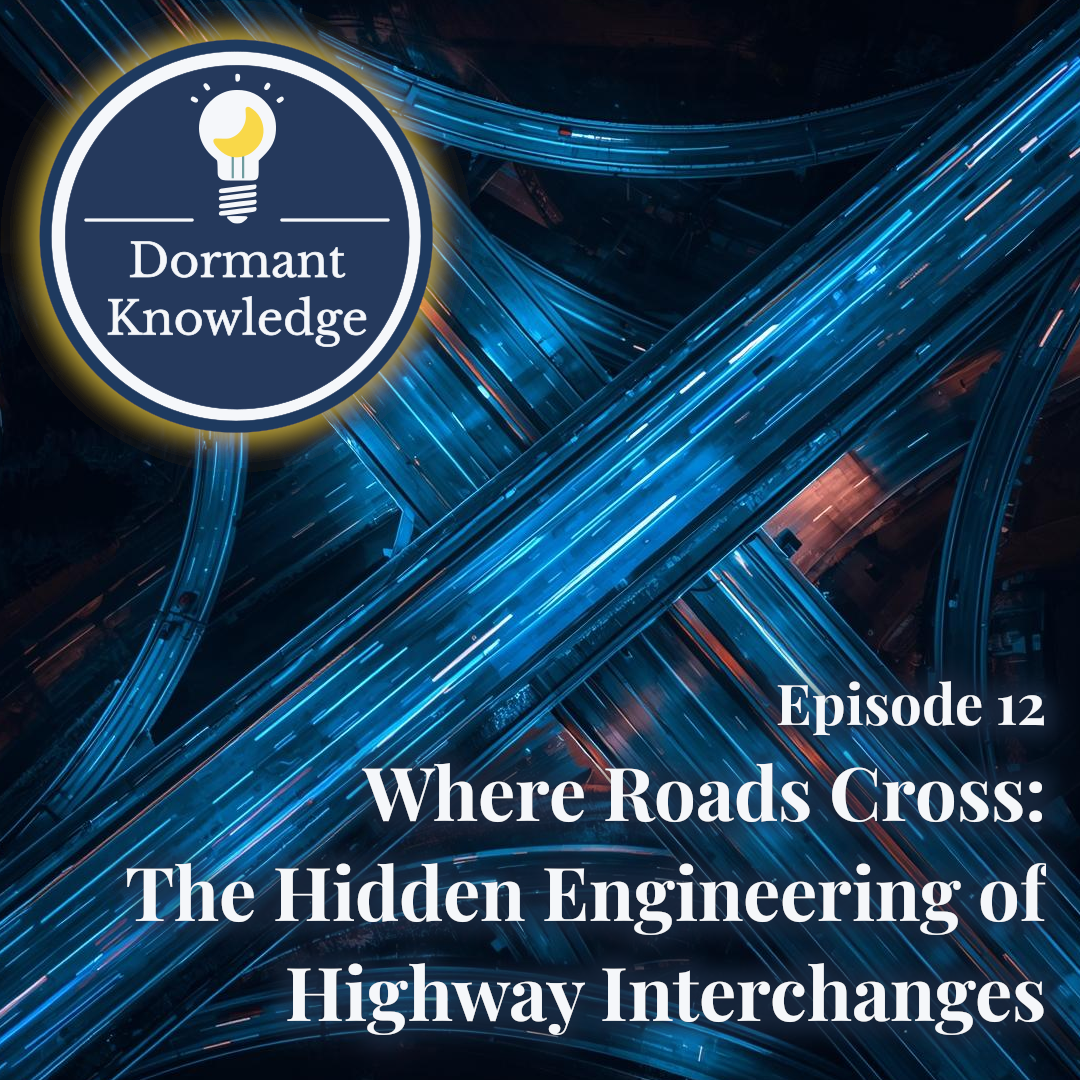
In this episode of Dormant Knowledge, the educational sleep podcast for curious minds, Deb explores the hidden engineering behind structures you've driven through hundreds of times without a second thought.
Host: Deb
Duration: 54 minutes
Release Date: December 1, 2025
Episode Topics: Highway Engineering, Transportation Infrastructure, Urban Design
Episode Summary
Journey into the surprisingly fascinating world of highway interchanges, those massive concrete structures where roads cross, loop, and merge in seemingly impossible ways. In this episode of Dormant Knowledge, the educational sleep podcast for curious minds, Deb explores the hidden engineering behind structures you've driven through hundreds of times without a second thought.
From the elegant cloverleaf designs of the 1920s to the towering five-level stacks of modern cities, highway interchanges represent decades of innovation in traffic engineering. These structures solved a critical problem: how to let high-speed traffic flow continuously while still allowing vehicles to change directions and cross paths safely.
Discover the stories behind iconic interchanges like New Jersey's pioneering cloverleafs, Robert Moses's transformative Long Island parkways, and Los Angeles's billion-dollar spaghetti junctions. Learn why some interchanges have "weaving problems," how engineers balance traffic flow with land use constraints, and what the future holds for these monuments to automobile culture.
Whether you're a transportation enthusiast, a frequent highway driver curious about the infrastructure beneath your wheels, or simply someone who appreciates the hidden complexity of everyday systems, this episode offers a relaxing deep dive into the engineering that keeps America moving. Settle in as Deb unravels the loops, levels, and logic of highway interchanges. Perfect bedtime learning for curious minds.
What You'll Learn
• Discover why highway interchanges became necessary in the early 20th century as automobiles grew faster and more common, and why simple traffic lights and roundabouts proved dangerously inadequate at highway speeds
• Learn how the cloverleaf interchange—one of the first and most elegant solutions—works with its distinctive four-leaf pattern, and why this seemingly perfect design has a fatal flaw called the "weaving problem"
• Explore the evolution from simple grade separations to complex multi-level "stack" interchanges, including the engineering challenges of building five-level structures that keep multiple highways flowing smoothly
• Understand how traffic engineers use mathematical models and computer simulations to predict flow patterns, calculate optimal ramp lengths, and determine safe merge speeds for new interchange designs
• Examine the innovative diverging diamond interchange (DDI) design that briefly moves traffic to the "wrong" side of the road to eliminate dangerous left turns and improve safety
• Consider the social and urban impacts of massive interchanges, from Robert Moses's controversial transformations of New York to the ways these structures have shaped American suburbanization and city development
• Investigate the staggering costs of modern interchange construction—from land acquisition to environmental impact assessments—and why the Judge Harry Pregerson Interchange in Los Angeles cost $1.3 billion to build
• Look ahead to the future of interchanges in an era of autonomous vehicles, climate adaptation, and changing urban transportation priorities, including whether we might need fewer of these structures in coming decades
Episode Transcript
[Soft ambient music fades in]
Deb: Welcome to Dormant Knowledge. I'm your host, Deb, and this is the podcast where you'll learn something fascinating while gently drifting off to sleep. Our goal is simple: to share interesting stories and ideas in a way that's engaging enough to capture your attention, but delivered at a pace that helps your mind relax and unwind. Whether you make it to the end or drift away somewhere in the middle, you'll hopefully absorb some knowledge along the way.
If you enjoy what we're doing here, you can find us at dormantknowledge.com or follow us on social media @dormantknowledge on Instagram and Facebook, or @drmnt_knowledge—that's d-r-m-n-t-underscore-knowledge—on X. We'd love to hear what topics you'd like us to explore next. And if you can spare it, we would really appreciate a contribution on BuyMeACoffee.com to help cover production costs. You can find us @DormantKnowledgePodcast.
Tonight, we're exploring something you've probably driven through hundreds of times without thinking much about it—highway interchanges. You know, those places where one highway meets another, and suddenly you're navigating loops and ramps and multiple lanes, trying to remember if you're supposed to stay left or merge right. They're these massive concrete structures that seem to spring up out of nowhere, and yet... well, there's actually a fascinating history and engineering story behind every single one of them. So settle in, get comfortable, and let's begin our journey into the surprisingly compelling world of highway interchanges.
[Music fades out]
[Pause]
So, um, let me start with a question that might seem obvious, but it's worth thinking about. Why do we even need these complicated interchange things in the first place? I mean, when two regular roads cross each other, you just put in a traffic light or a stop sign, right? Simple.
[Sound of shifting in chair]
But here's the thing—and this is where it gets interesting—highways are different. They're designed for continuous flow. Cars are moving at, you know, fifty-five, sixty-five, sometimes seventy miles per hour or more. And the whole point of a highway, really, is that you don't stop. That's what makes it a highway rather than just... a road.
So what happens when two of these high-speed, no-stopping routes need to cross each other? Well, that was the problem that engineers faced in the early twentieth century, as cars became faster and more common, and as people started thinking about connecting cities with these new automobile routes.
The early solutions were, uh... well, let's just say they were not great. [Laughs softly] Some places tried putting traffic lights right there on what were supposed to be high-speed roads. You can imagine how that went—cars barreling along at sixty miles an hour, suddenly coming up on a red light. Not ideal. Lots of accidents.
Others tried roundabouts, which work fine at lower speeds, but at highway speeds? Again, not so much. The problem with roundabouts at high speeds is that you're asking drivers to make these quick decisions—yield, merge, exit—while moving very fast, and that's just... it's a recipe for disaster, really.
So engineers realized they needed something different. They needed a way for traffic to cross without actually crossing, if that makes sense. The solution was what we call "grade separation"—one road goes over or under the other. No intersection at all, really. The traffic flows never actually meet.
[Pause]
But then, of course, you have a new problem. Because it's not enough for the roads to just cross over each other like an X. You also need to let cars move from one highway to the other. Someone driving north on Highway A needs to be able to get onto Highway B going east, or west, without stopping, and without causing a dangerous situation.
And that's where interchanges come in. An interchange is basically a system of ramps and bridges that lets traffic move between two or more highways in all possible directions, without anyone having to stop or slow down too much.
[Sound of paper rustling]
Now, the concept of grade separation—one route going over another—that actually predates automobiles. Railroads figured this out in the nineteenth century. When two railroad lines needed to cross, they'd build a bridge. One line would go over, the other under. Simple. But railroads don't need to change direction very often. A train on one line stays on that line. It's not like passengers are constantly switching from one railroad to another at every intersection.
Cars, though... cars need flexibility. They need options. So the challenge was much more complex.
The real development of highway interchanges happened in the 1920s and '30s, mostly in the United States and Germany. These were the countries building the first true automobile highways—what we'd call freeways or motorways.
In Germany, the autobahn system was being developed, and German engineers were experimenting with different interchange designs. And in the United States, well, several places were trying different things. New York, New Jersey, Los Angeles... these were the testing grounds for what would become standard interchange design.
[Pause]
One of the earliest and most influential designs was something called the cloverleaf. And I love this design because it's so... elegant, really, when you see it from above. It actually looks like a four-leaf clover, which is how it got its name.
The cloverleaf was invented, or at least first implemented, in New Jersey in the 1920s. There's some debate about who exactly invented it—several engineers were working on similar ideas around the same time—but one of the first functioning cloverleaf interchanges was built in Woodbridge, New Jersey, around 1928. And then Robert Moses—who we'll talk about more in a bit—he built several cloverleafs on Long Island in the 1930s.
So how does a cloverleaf work? Well, imagine you're looking down at it from above, like you're in an airplane. You've got two highways crossing each other, one going over the other on a bridge. That's your basic grade separation. But then, in each of the four quadrants—you know, the four corners where the highways would intersect if they were on the same level—in each of those corners, there's a loop. A circular ramp that curves around.
[Pause, slight yawn]
These loops are what let you change from one highway to another. If you're driving north on one highway and you want to go west on the other highway, you take the loop ramp in that quadrant. You exit your highway, curve around in a loop—making almost a complete circle—and then you're on the other highway going in the direction you wanted.
It's actually quite clever. The loops are designed so that you're always turning right, never crossing traffic. You exit to the right, loop around, and merge back onto the highway. From a traffic flow perspective, it's much safer than having traffic cross each other's paths.
The cloverleaf became incredibly popular in the mid-twentieth century. They were built all over the United States, and you can still find them today, though many have been replaced or modified over the years.
But—and here's the interesting part—the cloverleaf has a fatal flaw. Well, not fatal exactly, but a serious design problem that engineers eventually realized. It's called the "weaving problem."
[Sound of shifting papers]
See, the way a cloverleaf is designed, the exit ramp and the entrance ramp for each loop are pretty close together on the main highway. So what happens is... let's say you're on the highway, and you want to exit onto the loop. You move to the right lane to exit. But at the same time, someone who just finished going around the loop is merging back onto the highway, also in the right lane.
So you've got cars trying to exit, and cars trying to enter, all in the same section of highway, all needing to use the right lane. They have to weave around each other—hence "weaving problem." And this causes congestion, and also increases the risk of accidents, because you've got cars moving at different speeds, trying to occupy the same space.
As traffic volumes increased through the 1950s and '60s, this weaving problem became more and more of an issue. So engineers started looking for better designs.
[Pause]
And that brings us to what's probably the most impressive-looking type of interchange—the stack, or as it's sometimes called, the spaghetti junction.
Now, "spaghetti junction" isn't really an official engineering term. [Chuckles] It's more of a nickname, and it comes from... well, from the way these interchanges look from above. They're these massive tangles of curving ramps and bridges, all stacked on top of each other, and yeah, they do kind of look like a plate of spaghetti.
The most famous "spaghetti junction" is probably the Gravelly Hill Interchange in Birmingham, England. That's where the nickname really took off. It was built in the early 1970s, and it's this incredibly complex six-level interchange. It's got, I think, eighteen routes going through it? Something like that. And from above, it's just this wild tangle of concrete swooping in every direction.
But the stack interchange concept actually started in the United States, in Los Angeles, back in 1953. The Four-Level Stack, or the Bill Keene Memorial Interchange—it's where I-110 meets US Route 101, downtown Los Angeles. And when it opened, it was considered an engineering marvel. It was the first interchange in the world to use four separate levels to handle traffic flow.
[Pause]
The beauty of a stack—from an engineering perspective, anyway—is that it solves the weaving problem. Instead of using loops where traffic has to merge and weave, a stack uses direct connections. If you're going from one highway to another, there's a dedicated ramp that takes you there. No loops, no weaving. Just a smooth, direct connection.
But to make this work, you need multiple levels. The ramps have to go over and under each other in a carefully choreographed pattern. Hence the "four-level" part. And this is where stack interchanges get expensive and complicated. You're building bridges on top of bridges, sometimes five or six levels high. The engineering is incredibly complex, and the cost... well, let's just say these things are not cheap.
[Soft ambient music begins to fade in]
Deb: I'm going to take a quick break here. When we come back, we'll continue with more about these fascinating interchange designs, including a really revolutionary new type that completely flips the script on how we think about traffic flow.
[Music plays for transition]
Deb: Welcome back to Dormant Knowledge...
[Music fades out]
[Pause]
So, before the break, we were talking about stack interchanges—these massive, multi-level structures that solve traffic flow problems through sheer vertical complexity. And, um, I mentioned they're expensive. Let me give you some numbers to put that in perspective.
[Sound of paper rustling]
A typical cloverleaf interchange might cost, I don't know, five to ten million dollars to build. Maybe a bit more in today's dollars with inflation. But a major stack interchange? We're talking hundreds of millions. The judge Harry Pregerson Interchange in Los Angeles—which is a massive stack that connects several highways—that cost over $1.3 billion when it was built in the 1990s. Billion. With a B.
And that's just construction costs. You've also got land acquisition, which in urban areas can be incredibly expensive, and then there's ongoing maintenance, which for these massive concrete structures is no small thing.
[Pause]
But let's talk about a completely different type of interchange now, one that's much more recent and, honestly, pretty mind-bending when you first encounter it. It's called the diverging diamond interchange, or DDI for short.
The diverging diamond is fascinating because it takes everything you think you know about traffic flow and just... flips it. Literally. And it was only invented—or at least first implemented—in 2009. So this is very new in the history of highway engineering.
Here's how it works, and bear with me because it sounds weird at first. You've got a regular highway, and there's an overpass—a road that goes over the highway. Pretty standard so far. But instead of having the usual on-ramps and off-ramps, a diverging diamond does something unusual.
The road on top—the one crossing over the highway—it temporarily switches to the opposite side. So if you're driving on this road, you're normally on the right side, right? But as you approach the interchange, the traffic crosses over, and suddenly you're on the left side. Then you cross the highway while you're on the left side, and then after you cross, the traffic crosses back over to the right side again.
[Pause]
I know, I know. It sounds confusing. And the first time you drive through one, it is a little disorienting. You're suddenly on what feels like the wrong side of the road, even though you're not, because all the other cars are there with you.
But here's why it works, and why it's actually brilliant. When you're on the left side of the road, making a left turn onto the highway—which is usually the difficult movement that causes backups—becomes easy. You don't have to cross oncoming traffic. You just... merge. It's like making a right turn, in terms of the traffic pattern, even though directionally you're going left.
And the safety statistics on diverging diamonds are remarkable. They've shown significant reductions in accidents compared to traditional interchange designs. Some studies show a forty percent reduction in collisions. That's huge.
[Yawns softly]
The first diverging diamond in the United States was built in Springfield, Missouri, in 2009. And since then, they've spread rapidly. As of... I think 2024, there are over a hundred of them across the US, and more being planned. They're especially popular for replacing older, more congested interchanges, because they can handle higher traffic volumes in a smaller footprint than traditional designs.
There are other new designs too, though the diverging diamond is probably the most notable. There's something called a "displaced left turn" intersection, which uses a similar principle of moving turning traffic to a different position before the main intersection. And there's the "continuous flow intersection," which eliminates the need for left-turn signal phases.
These modern designs are all about maximizing traffic flow and safety while minimizing the amount of space and infrastructure needed. Because, you know, we're not building as many brand new highways anymore. Most of the interstate system is already built. So now the challenge is making existing interchanges work better.
[Pause]
Let's talk about the names of these different interchange types, because, well, engineers love their terminology, and some of these names are quite amusing when you think about them.
We've already talked about the cloverleaf and the stack. But there are so many others. There's the "trumpet" interchange, which is used when a smaller road joins a highway. It's called a trumpet because, from above, it supposedly looks like a trumpet. Though honestly, you kind of have to squint and use your imagination.
[Chuckles softly]
Then there's the "parclo," which is short for "partial cloverleaf." It's basically a cloverleaf but with only some of the loops, usually used when you don't need full movement in all directions. Engineers love abbreviations, apparently.
And there's the SPUI—that's S-P-U-I—which stands for "single-point urban interchange." This is a design where all the turning movements happen at one single point under the bridge. It's space-efficient, which makes it popular in built-up areas where land is expensive.
You've also got the directional T, directional Y, turbine, and windmill interchanges. The turbine is particularly interesting—it's like a cloverleaf, but instead of having complete loops, it has these curved ramps that sweep around at higher speeds. From above, it looks kind of like a turbine blade, hence the name.
[Sound of shifting in chair]
Different regions tend to favor different designs based on their specific needs and, well, their engineering culture. Texas, for example, is famous for building these absolutely massive interchanges. Everything's bigger in Texas, as they say, and that apparently includes highway infrastructure. The "High Five" interchange in Dallas, which connects two major highways, has five levels—five!—and cost over $260 million to build back in 2005.
California has its own style too, partly because of earthquake considerations. You can't just build massive concrete structures without thinking about seismic activity. So California interchanges often have specific design features to handle potential earthquakes—reinforced columns, flexible connections, that sort of thing.
[Pause]
Now, we can't talk about highway interchanges without mentioning Robert Moses, because he's such a towering figure in the history of American highway development. Love him or hate him—and opinions are very divided—Moses shaped modern New York, and his influence extended far beyond that.
Robert Moses was never elected to anything. He was a bureaucrat, essentially—but a bureaucrat with enormous power. Over his career, which spanned roughly from the 1920s through the 1960s, he oversaw the construction of hundreds of miles of highways, dozens of bridges, numerous parks, and countless other public works projects in New York.
And Moses was a true believer in the automobile as the future of transportation. He built parkways—limited-access roads designed for recreational driving—and later, highways that carved through the urban landscape. He was responsible for many of the early interchanges in the New York area, including several cloverleafs on Long Island.
[Pause]
Moses's approach to building highways was, um... let's say aggressive. When he decided a highway should go through a particular area, it went through that area, regardless of what was there before. Neighborhoods, parks, historical buildings—if they were in the way, they came down.
And this brings us to one of the more complicated aspects of highway history. The construction of the interstate highway system in the 1950s and '60s was an enormous undertaking. It connected cities, facilitated commerce, enabled suburban development. But it also involved demolishing thousands of buildings and displacing hundreds of thousands of people from their homes.
The interstate routes often followed paths of least political resistance, which frequently meant going through lower-income neighborhoods rather than wealthier areas. This had lasting effects on American cities that we're still grappling with today.
[Pause]
But there was pushback. By the 1960s and '70s, what became known as the "freeway revolt" movement emerged. Citizens groups in various cities began organizing to stop planned highways from being built through their neighborhoods. San Francisco famously halted several planned freeways, including one that would have run along the waterfront. Seattle stopped an interstate that would have cut through its downtown. New York City eventually rejected several of Moses's proposed highways.
These movements marked a shift in how Americans thought about urban planning and the role of highways. The question changed from "How do we build more highways?" to "Do we need this highway at all? And if so, where should it go?"
[Sound of paper rustling]
Some cities have even removed highways that were built during this era. San Francisco tore down the Embarcadero Freeway in the 1990s, opening up the waterfront. Boston famously buried its central artery—the "Big Dig" project that took over a decade and cost over $14 billion. The result is that downtown Boston now has parks and open space where an elevated highway used to be.
[Pause, slight yawn]
But let's get back to the engineering side of things, because there's something I find really interesting about the actual construction challenges of building these interchanges.
Take drainage, for example. When you build a massive interchange with multiple levels of roadway, you create all these horizontal surfaces that collect water. Rain falls, snow melts, and all that water has to go somewhere. You can't just let it pool on the roadway—that causes hydroplaning and ice formation.
So engineers have to design elaborate drainage systems. Storm drains, catch basins, retention ponds. And the water that runs off highways isn't clean—it picks up oil, tire particles, road salt, all kinds of pollutants. So there are also environmental considerations about where that runoff goes and how it's treated before it enters rivers or groundwater.
Foundation engineering is another challenge. These massive concrete structures weigh thousands of tons. You're building bridges on top of bridges, remember. So the foundation has to be incredibly strong, and it has to be designed for the specific soil conditions at that location. In some places, you're building on bedrock, which is relatively straightforward. In other places, you're building on clay or sand, which can settle or shift over time.
[Pause]
And then there's the mathematics of it all. The curves of the ramps, the angles of the merges—these aren't arbitrary. They're carefully calculated based on vehicle speeds, driver reaction times, and the physics of how cars move.
For example, when you're designing a merge lane—where a ramp joins the main highway—you need to give drivers enough distance to accelerate from ramp speed to highway speed and find a gap in traffic. Too short, and it's dangerous. Too long, and you're wasting space and money. The typical merge lane is somewhere between 600 and 1,500 feet, depending on the speed differential and traffic volumes.
The curves of ramps also have to be designed with specific radius calculations. Too sharp, and cars have to slow down too much. Too gentle, and you're using a lot of land. And you have to account for the banking—the way the road tilts in the curve—to help vehicles maintain speed through the turn.
[Soft ambient music begins to fade in]
Deb: I'm going to take another short break here. When we come back, we'll talk about some of the global variations in interchange design, and how these structures connect to broader changes in American life—suburbanization, car culture, and the way we think about distance and time.
[Music plays for transition]
Deb: That music is making me drowsy... If you're still with us, welcome back to Dormant Knowledge.
[Music fades out]
[Pause]
So, one thing that's interesting when you look at highway interchanges around the world is how much they vary based on local conditions and cultural preferences.
In Europe, for example, you'll find fewer of these massive multi-level interchanges and more roundabouts. Now, European roundabouts aren't like American ones, where they're just a circular intersection at surface level. European highway roundabouts are often grade-separated, with ramps leading up to a circular roadway that's elevated or depressed from the main highway level.
These roundabouts handle traffic quite efficiently, and they take up less space than something like a stack interchange. They also tend to be safer, because all the traffic is moving in the same direction—no crossing paths, no weaving. Speeds are lower in the roundabout itself, which gives drivers more time to make decisions.
[Pause]
Japan has developed some fascinating space-efficient designs, because, well, space is at a premium in Japanese cities. They've built some interchanges that are remarkably compact, using tight loops and steep grades to fit everything into a small footprint. Some of these wouldn't meet American highway standards, which tend to prioritize gentler curves and grades, but they work fine for Japanese traffic patterns and driver expectations.
China, being a relative latecomer to mass automobile ownership, has been able to build modern interchanges from scratch, incorporating the latest design principles. Some of their new interchanges are absolutely massive—these huge, sweeping structures that look like abstract sculptures from above. They've got the space and the budget to build big, and so they do.
In the Middle East, particularly in places like Dubai and Saudi Arabia, you'll find some of the most elaborate interchanges in the world. Money is less of a constraint, and they're building for projected future traffic rather than current needs, so you get these oversized, very impressive structures.
[Yawns]
But let's bring this back to the United States, because I want to talk about how interchanges connect to some bigger themes in American history—particularly suburbanization and car culture.
The interstate highway system, which was authorized by Congress in 1956, was transformative. Before the interstates, long-distance travel meant either trains or two-lane roads that went through every small town between your starting point and your destination. Traveling from, say, New York to Los Angeles could take a week or more.
The interstates changed that. Suddenly you could drive coast to coast in a few days, on divided highways with limited access—meaning no driveways, no traffic lights, just continuous flow.
And the interchanges were the key to making this system work. Every place where two interstates met, you needed an interchange. And these interchanges became more than just traffic infrastructure—they became the focal points for development.
[Sound of shifting in chair]
This is where the concept of the "edge city" comes from. An edge city is basically a concentration of business, shopping, and entertainment outside of a traditional downtown, usually clustered around a major highway interchange. You'd have a shopping mall, office parks, hotels, restaurants, all built up around the interchange because that's where the accessibility was.
Think about it—if you're a business deciding where to locate, you want to be where people can easily reach you. And in the automobile age, that means being near a major highway. But not just anywhere on the highway—you want to be right at an interchange, where people are getting on and off.
So these interchange areas became these mini-cities in their own right. Sometimes they rivaled or even surpassed the original city center in terms of economic activity.
This had profound effects on American urban development. It enabled suburban sprawl, for one thing. People could live farther from where they worked because the highways made commuting viable. The concept of distance changed—it wasn't measured in miles anymore, but in drive time. "Oh, it's only twenty minutes away," became a meaningful measure, even if "away" was actually thirty miles.
[Pause]
And this brings us to some of the environmental considerations. Highways and interchanges create these huge swaths of impermeable surface—concrete and asphalt that doesn't absorb water. This changes local hydrology, increases runoff, contributes to flooding. The heat island effect in cities is partly due to all this dark pavement absorbing and radiating heat.
There's also the question of whether we're still building these massive interchanges at the rate we once were. And the answer is... not really. The initial build-out of the interstate system is largely complete. We're now in an era of maintenance and modification rather than major new construction.
And there's growing discussion about whether some highways and interchanges should actually be removed. This isn't just a fringe idea—several cities are seriously considering or actively working on projects to remove or reconfigure urban highways that divide neighborhoods or occupy valuable land that could be used differently.
[Pause]
But interchanges aren't going away anytime soon. Even if we stopped building new ones tomorrow, the thousands that already exist need to be maintained, and occasionally rebuilt. And that's its own challenge, because these structures were generally designed with a fifty-year lifespan, and many of them are now approaching or exceeding that age.
Concrete deteriorates. The freeze-thaw cycles in cold climates are particularly destructive—water gets into tiny cracks, freezes and expands, making the cracks bigger, and eventually you get serious structural damage. The rebar inside the concrete can rust, which also causes cracking and spalling.
Maintaining these structures is expensive and difficult. You can't just shut down a major interchange for months to repair it—well, you can, but it causes massive traffic disruptions. So engineers have to come up with creative solutions, working at night, in stages, trying to keep traffic moving while also doing necessary repairs.
[Pause, sound of sipping water]
Let's talk a bit about the aesthetic dimension of interchanges, because there's an interesting conversation to be had there. Are these structures beautiful? Ugly? Both?
From a certain perspective, there's something aesthetically impressive about a well-designed interchange. The curves are mathematically precise. The way the ramps weave over and under each other can be almost graceful, in a brutalist sort of way. The massive concrete pillars holding up multiple levels of roadway—there's a kind of industrial beauty to it.
Photographers and drone operators have discovered this. There's a whole genre of photography now that focuses on highways and interchanges from above, and some of these images are genuinely striking. The patterns, the symmetry, the sense of scale—it's visually interesting in a way that people don't usually notice when they're driving through these structures at highway speed.
[Chuckles softly]
Cities: Skylines, the city-building video game, has a whole community of players who compete to build the most elaborate and beautiful interchanges. People spend hours designing these intricate multi-level structures that would probably cost billions of dollars in real life, just for the satisfaction of solving the traffic flow puzzle and creating something visually impressive.
So there's definitely an aesthetic appreciation for these structures in certain circles. But there's also the opposing view—that interchanges are ugly scars on the landscape, brutal concrete structures that divide communities and dominate the visual environment.
It's probably fair to say both perspectives have merit. A massive interchange in the middle of a city is certainly imposing, and not necessarily in a good way. But viewed from the right angle, or in the right context, there can be a certain beauty to the engineering and the form.
[Pause]
Let's look ahead a bit and think about what the future might hold for interchanges. There are a few trends and technologies that could significantly change how we think about these structures.
First, there's autonomous vehicles. If cars can drive themselves and communicate with each other, they can potentially handle much closer spacing and more complex merging patterns than human drivers can. This might mean that some of the design principles that currently govern interchange design could be relaxed. You might not need as long merge lanes, for example, if computers are handling the merging instead of humans.
Or we might need fewer interchanges altogether, if autonomous vehicles can be coordinated through a central system that routes them efficiently. Though I think that's probably a longer-term possibility.
[Yawns]
There's also the concept of "smart" interchanges with adaptive signals and real-time traffic management. Instead of fixed timing on ramp meters, you'd have systems that respond to current traffic conditions, adjusting to keep traffic flowing as smoothly as possible.
And there's the climate question. As we think about adapting infrastructure to more extreme weather—heavier rainfall, more intense heat, freeze-thaw cycles in areas that didn't used to experience them—we'll need to design interchanges that can handle these conditions.
Some of this will mean rebuilding or retrofitting existing structures. Some of it will mean rethinking how we design new ones.
[Pause]
There's also an interesting philosophical question about whether we've reached "peak car"—the idea that car ownership and usage might have peaked and will decline from here. Younger generations in urban areas seem less interested in car ownership than previous generations. Transit and bike infrastructure is expanding in some cities. Remote work reduces commuting.
If car usage does decline, what happens to all these interchanges? Do we need to maintain all of them? Could some be simplified or removed? These are questions that transportation planners are starting to grapple with.
[Sound of papers shuffling]
Before we wrap up, let me share a few surprising facts and misconceptions about interchanges.
There's a persistent legend that the interstate highway system was designed so that one mile in every five had to be straight and flat, to serve as emergency runway for military aircraft. You hear this one a lot. But it's not actually true. While the interstate system does have military value—it was officially called the "National System of Interstate and Defense Highways"—there's no requirement for emergency runways. It's just a myth that sounds plausible enough that people keep repeating it.
[Pause]
The most expensive interchange ever built is probably the Judge Harry Pregerson Interchange in Los Angeles, which I mentioned earlier—$1.3 billion. Though if you adjust for inflation and include some of the costs associated with Boston's Big Dig, those interchanges might be more expensive.
The interchange with the most levels... well, that depends on how you count, but some sources say the High Five in Dallas, with its five levels, holds that record in the United States. Internationally, some interchanges in China and Japan might have more levels, though again, it depends on how you define "levels."
There's also a common misconception that highway interchanges are more dangerous than regular intersections. But actually, well-designed interchanges are generally quite safe. The accident rates on properly designed interchanges are lower than on surface streets, because you've eliminated the most dangerous type of accident—the head-on collision. When all traffic is moving in the same general direction, even if there's a collision, it's usually less severe.
[Soft ambient music begins to fade in]
So, what have we learned about highway interchanges? They're these fascinating pieces of infrastructure that we mostly take for granted, but they represent decades of engineering evolution. From the early cloverleafs to the massive stacks to the innovative diverging diamonds, each design solves specific problems in traffic flow.
They're also deeply connected to broader changes in American life—the rise of suburbanization, the dominance of car culture, the transformation of our cities and landscapes. They enabled a particular way of living and moving through space that defined much of twentieth-century America.
And they're not static. They continue to evolve, as engineers develop new designs and as we grapple with questions about maintenance, sustainability, and whether the future will be as car-centric as the past.
The next time you're driving through a major interchange—navigating those curves and ramps, maybe feeling briefly disoriented about which lane you should be in—maybe you'll think about the engineers who designed it, the workers who built it, and the complex dance of traffic flow that's happening all around you. It's infrastructure we tend to ignore, but there's really quite a bit going on there.
[Pause]
Thank you for listening to Dormant Knowledge. If you're still awake and hearing my voice, I appreciate your attention. But if you've drifted off to sleep somewhere along the way—which was partly the goal—then you won't hear me say this anyway. Either way, I hope some knowledge about highway interchanges has made its way into your consciousness or perhaps your dreams.
Until next time, this is Deb wishing you restful nights and curious days.
[Music swells and fades out]
END OF EPISODE
Show Notes & Resources
Key Engineering Concepts Explained
Grade Separation
The fundamental principle behind highway interchanges where one roadway passes over or under another, eliminating the need for traffic to stop or cross paths at the same level. This concept was borrowed from 19th-century railroad engineering but required significant adaptation for automobile traffic.
Cloverleaf Interchange
One of the earliest interchange designs, recognizable from above by its four-leaf clover shape. Features loop ramps in each quadrant that allow vehicles to change highways while always turning right. Pioneered in New Jersey in the 1920s and popularized by Robert Moses on Long Island in the 1930s. While elegant, cloverleafs create "weaving problems" where entering and exiting traffic must share the same lane space.
Weaving Problem
A traffic flow issue that occurs when exit and entrance ramps are too close together, forcing vehicles to cross paths as some cars try to exit while others merge onto the highway. This creates congestion and increases accident risk, particularly problematic in older cloverleaf designs.
Stack Interchange (Spaghetti Junction)
A complex multi-level interchange design where ramps pass over and under each other in multiple layers to accommodate all directional movements. These can reach four or five levels and are often called "spaghetti junctions" due to their tangled appearance from above. The High Five Interchange in Dallas is a prominent five-level example.
Diverging Diamond Interchange (DDI)
An innovative design from the 2000s where traffic briefly crosses to the opposite side of the road, eliminating dangerous left turns across opposing traffic. Though initially counterintuitive for drivers, DDIs have proven effective at improving traffic flow and safety while using less space than traditional designs.
Directional Interchange
Also known as a "directional T" or "turbine" interchange, this design uses sweeping, high-speed ramps to connect highways with minimal weaving. These interchanges require more land than cloverleafs but handle traffic more efficiently and are often used for major highway connections.
Ramp Metering
Traffic signals placed on entrance ramps that control the rate at which vehicles merge onto highways, preventing sudden traffic surges that cause congestion. Though seemingly counterintuitive, metering actually improves overall traffic flow by maintaining consistent speeds on the main highway.
Notable Interchanges and Infrastructure
Woodbridge Cloverleaf (New Jersey, 1928)
One of the first functioning cloverleaf interchanges in the United States, this pioneering structure demonstrated the viability of grade-separated interchange design for automobile traffic.
Robert Moses's Long Island Parkways (1930s)
New York's influential "master builder" Robert Moses constructed several early cloverleaf interchanges on the Long Island parkway system, helping establish this design as the American standard for mid-century highway development. Moses's work was controversial for its impact on urban communities but profoundly shaped American transportation infrastructure.
Los Angeles Four-Level Interchange (1949)
Opened in 1949 at the intersection of US 101 and the Harbor Freeway (I-110), this was one of the first stack interchanges in the United States and became an iconic symbol of Los Angeles automobile culture. Its distinctive multilevel design was featured in countless films and photographs.
Judge Harry Pregerson Interchange (Los Angeles)
Completed in 1993, this massive interchange connects Interstate 105 and Interstate 110 south of downtown Los Angeles. At approximately $1.3 billion in construction costs, it remains one of the most expensive interchanges ever built, featuring soaring ramps that reach heights of over 100 feet.
High Five Interchange (Dallas, Texas)
Built in 2005 at the junction of Interstate 635 and US Highway 75, this five-level stack interchange stands up to 12 stories high at its tallest point. Its distinctive height and complex ramp system earned it the nickname "High Five" and it remains one of the tallest interchanges in the United States.
Springfield Interchange (Virginia)
Often called the "Mixing Bowl," this interchange south of Washington, D.C., serves as the junction of Interstate 95, Interstate 495 (Capital Beltway), and Interstate 395. A massive reconstruction project completed in 2007 cost approximately $700 million and created one of the most complex interchange systems in the eastern United States.
Modern Highway Engineering and Future Considerations
Autonomous Vehicle Impacts
Self-driving vehicles that can communicate with each other may eventually handle closer spacing and more complex merging patterns than human drivers, potentially allowing for shorter merge lanes and more efficient interchange designs. However, these changes likely remain decades away as autonomous technology develops and adoption spreads.
Smart Traffic Management Systems
Modern interchanges increasingly incorporate adaptive traffic signals, real-time monitoring, and dynamic ramp metering that responds to current conditions rather than operating on fixed timing. These systems aim to optimize flow and prevent the cascade effects that turn minor slowdowns into major traffic jams.
Climate Adaptation Requirements
As weather patterns become more extreme with climate change, engineers are rethinking interchange design to handle heavier rainfall, more intense heat, and freeze-thaw cycles in areas that historically didn't experience them. This includes improved drainage systems, heat-resistant materials, and resilient structural designs.
Peak Car and Changing Transportation Priorities
Some urban planners question whether car usage has peaked, particularly as younger generations show less interest in car ownership and cities invest in transit, cycling infrastructure, and walkable design. These trends raise questions about whether all existing interchanges need to be maintained or if some could be simplified or removed.
Environmental and Community Impact Assessments
Modern interchange projects face extensive environmental review processes that were largely absent during the mid-20th century highway boom. Projects must now address air quality, noise pollution, community disruption, historical preservation, and habitat protection—considerations that significantly increase both costs and project timelines.
Further Learning
Books
"The Power Broker: Robert Moses and the Fall of New York" by Robert Caro
This Pulitzer Prize-winning biography examines Robert Moses, one of the most influential figures in American highway development. While focused on New York, the book provides essential context for understanding how highway infrastructure shaped 20th-century American cities and the social costs of prioritizing automobile infrastructure.

"Interstate: Highway Politics and Policy Since 1939" by Mark H. Rose
A comprehensive examination of the political and policy decisions that created America's interstate highway system, including detailed discussions of interchange design standards and the federal-state partnerships that built the nation's highway network.

"Traffic: Why We Drive the Way We Do (and What It Says About Us)" by Tom Vanderbilt
While not exclusively about interchanges, this accessible book explores traffic flow psychology and engineering, including chapters on highway design, merge behavior, and how infrastructure shapes driving patterns.

Documentaries and Video Resources
"Taken for a Ride" (PBS, 1996)
Documentary examining the social and environmental costs of America's highway system expansion, including how interchange construction disrupted urban communities.
 POV
POV
"10 Days That Unexpectedly Changed America: Eisenhower's Interstate Highway System" (History Channel)
Profile of President Eisenhower's role in creating the interstate highway system and the broader impacts of this massive infrastructure project.
Online Resources
Federal Highway Administration (FHWA) - Interstate System Information
https://www.fhwa.dot.gov/interstate/
Official government resource providing historical information, current statistics, and design standards for the interstate highway system, including technical documentation on interchange design guidelines.
American Association of State Highway and Transportation Officials (AASHTO)
https://www.transportation.org/
Professional organization that publishes design standards and best practices for highway infrastructure, including the "Green Book" guide to geometric design of highways and streets.
Aerial Photography Collections
Various photographers and drone operators have documented highway interchanges from above, revealing the geometric beauty and complexity of these structures. Search for "highway interchange aerial photography" to find striking visual documentation of these engineering achievements.
Cities: Skylines Community
The city-building video game has spawned an active community of players who design elaborate interchange systems. While recreational, these communities demonstrate widespread public fascination with interchange design and traffic engineering principles.
Academic and Technical Resources
Transportation Research Board (TRB)
Part of the National Academy of Sciences, TRB publishes research on transportation engineering including studies on interchange safety, traffic flow optimization, and design innovation.
"A Policy on Geometric Design of Highways and Streets" (AASHTO Green Book)
The definitive technical manual for highway design in the United States, including detailed specifications for interchange geometry, ramp design, and sight distance requirements. Used by transportation engineers nationwide.
 iENGINEERING Admin
Episode Tags
#HighwayEngineering #Infrastructure #TransportationHistory #CivilEngineering #UrbanPlanning #RobertMoses #CloverleafInterchange #TrafficFlow #InterstateHighway #SleepPodcast #EducationalContent #Engineering #AmericanHistory #ModernInfrastructure #AutomotiveCulture
Listen to Episode 11
Available on all major podcast platforms:
Or visit: dormantknowledge.com
Dormant Knowledge is the educational sleep podcast for curious minds. Each episode explores fascinating but obscure topics delivered in a gentle, conversational style designed to help you learn while drifting off to sleep.
Follow us:
Instagram & Facebook: @dormantknowledge
X (Twitter): @drmnt_knowledge
Support the show:
BuyMeACoffee.com/@DormantKnowledgePodcast